
Accelerate high-quality development of Liuzhou by promoting investment attraction, strengthening industrial development, optimizing business environment, and transforming work style
Source:Liuzhou Daily Date:2026-02-25 18:50
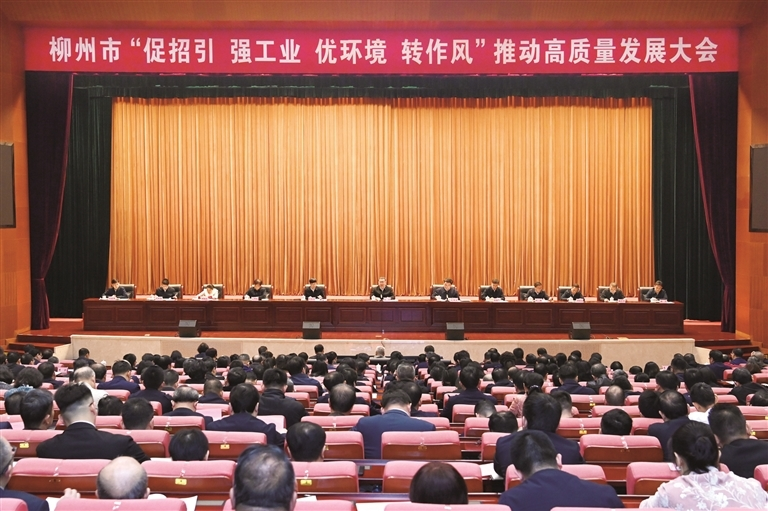
At the meeting. (All photos in this article are taken by Huang Rui, a multimedia reporter)
As the saying goes, spring arrives early in the southern regions, where diligence breeds treasures from the soil. On February 24, marking the first working day following the Spring Festival, the CPC Liuzhou Municipal Committee and Liuzhou Municipal People’s Government convened a citywide meeting titled "Promoting Investment Attraction, Strengthening Industrial Development, Optimizing Business Environment, and Transforming Work Style" to accelerate high-quality development. This meeting earnestly implemented the decisions and directives of the Central Committee of the Communist Party of China and the CPC Guangxi Committee, firmly establishing the clear orientation of "focusing on practical work, valuing innovation as the core, speaking through performance, and enabling the people to have a say". With a mindset geared towards liberating thoughts, embracing responsibility, adhering to principles, and innovating for transformation, Liuzhou is acting with a sense of urgency that brooks no delay, a sense of crisis that tolerates no slackness, and a sense of responsibility that permits no inaction to fully promote breakthroughs in investment attraction, accelerate industrial development, significantly enhance the business environment, and achieve a major transformation in work style. Efforts will be made to advance new industrialization, foster new productive forces, and establish a robust manufacturing city. Zhang Zhuang, Secretary of the CPC Liuzhou Municipal Committee, attended the meeting and delivered a speech, while Mayor Liu Shengyou presided over the proceedings. Song Zhenhuan, Chairman of the Standing Committee of the Liuzhou Municipal People's Congress, Cai Lihua, Secretary of the Party Leadership Group of the CPPCC Liuzhou Municipal Committee, and Suo Shenjing, Deputy Secretary of the CPC Liuzhou Municipal Committee, were also in attendance.
Zhang Zhuang pointed out that advancing high-quality development in Liuzhou necessitates prioritizing six critical aspects, namely industry as the cornerstone, investment attraction as the focus, projects as the tangible manifestation, environment as the foundation, innovation as the driving force, and work style as the guarantee. These six elements are interrelated, mutually reinforcing, and collectively constitute an integrated framework. They must be systematically aligned, promoted in a coordinated manner, and implemented concurrently. It is imperative to recognize that fostering investment attraction, strengthening industrial development, optimizing business environment, and transforming work style are pragmatic measures to actualize General Secretary Xi Jinping's significant insights on high-quality development, which represent essential actions to effectively implement the strategic decisions and directives of Guangxi, address the practical need to consolidate and enhance development momentum, and serve as pivotal steps toward achieving the objectives outlined for the "15th Five-Year Plan" period. Focused efforts must be directed toward stabilizing existing assets, increasing incremental growth, and addressing dynamic variables. Continuous attention should be given to investment attraction, project execution, environmental optimization, innovation, resource allocation, and operational efficiency. Every effort must be made to revitalize traditional industries, expand emerging sectors, reshape the industrial pattern, and expedite Liuzhou's high-quality development.
Zhang Zhuang underscored the paramount importance of investment promotion and attraction as the foremost priority for Liuzhou in advancing high-quality economic development at present. The strategic direction for attracting investment must be in line with the "24-character requirements", which include "attracting leading enterprises, strengthening industries, addressing weaknesses, gathering clusters, aiming for high grounds, focusing on breakthroughs, making careful selections, and improving quality", thus to foster the development of the ten modernized pillar industries with scale and market, and in chains and clusters. It is imperative to distinctly recognize Liuzhou's advantages in terms of location, foundation, scenarios, policies, and talent in investment promotion, fully harness the potential of the industrial guidance fund, and steadfastly adhere to identifying priorities in measures, fortifying breakthroughs in priorities, and pursuing tangible outcomes in breakthroughs. A comprehensive investment promotion framework should be instituted, distinguished by "scenario-driven, fund-driven, synergy-driven, government-enterprise collaboration, city-county interaction, and full participation".
Zhang Zhuang emphasized the imperative to fully commit to fortifying the industry and consolidating the foundation of high-quality development. It is crucial to adhere to the "dual strategy" of revitalizing existing assets and expanding new growth, expediting the transformation of Liuzhou's current industries towards innovation, advancing towards intelligence, striving for excellence, and expanding externally, while comprehensively optimizing and upgrading the industrial system. Efforts should be directed towards vigorously implementing cultivation and multiplication plans for high-growth enterprises, significantly expanding the artificial intelligence terminal and robotics industries, and accelerating the development of Guangxi's artificial intelligence application scenarios and industrial cluster innovation base. The "1071" industrial development promotion mechanism must be rigorously enforced to swiftly convert the outcomes of project construction into momentum that propels high-quality development.
Zhang Zhuang underlined the imperative of reinforcing a service-oriented mindset to establish a convenient and efficient governmental framework, thereby advancing the transformation of government services from being merely "able to handle" to becoming "easy to handle, fast to handle, and excellently handled". It is essential to strengthen the principle of integrity, foster an honest and trustworthy credit environment, and ensure integrity in attracting, accommodating, and retaining businesses. The prioritization of fairness must be emphasized to cultivate a fair and orderly market environment, facilitate more open and transparent resource allocation and factor supply, and ensure that governmental power operates under conditions of transparency and accountability. Furthermore, the principle of mutual benefit should be reinforced to create a cooperative and mutually advantageous open environment. This includes positioning Guangxi as a central growth hub for maritime-oriented and open development, while capitalizing on the synergies of "canal + industry" and "corridor + hub" to promote the outward movement of products, standards, and vocational education. Lastly, the prioritization of business-friendliness must be strengthened to nurture a culture that values and respects enterprises, thereby fostering a favorable ecosystem for attracting, accommodating, supporting, and benefiting businesses.
Zhang Zhuang stressed that the effectiveness of advancing investment attraction, enhancing industry, and optimizing the environment is fundamentally dependent on the government personnel. It is essential to further transform the work style and cultivate a new one, firmly instilling the correct perspectives on power, achievements, and career, while rigorously implementing the "3321" cadre assessment and evaluation mechanism. Focused efforts must be directed towards addressing the "ten persistent issues" of mediocrity, indolence, laxity, sluggishness, procrastination, indulgence in eating and drinking, recreational distractions, idleness, and evasion. Instead, the "ten guiding principles" of striving for excellence, diligence and responsibility, adherence to rules and discipline, efficiency, prompt action, "restrained eating", "moderate drinking", appropriate enjoyment, accountability, and dedication to one's role should be established. Issues should be solved through tangible actions, development should be fostered through concrete achievements, and persistently endeavor should be made to secure new advantages and forge new circumstances.
During his address, Liu Shengyou underscored the importance of unified thinking and coordinated implementation, urging all stakeholders to align their perspectives and actions with the directives and strategic plans of the CPC Liuzhou Municipal Committee and Liuzhou Municipal People’s Government. This alignment, he emphasized, is essential to building a robust consensus and fostering collective efforts to advance high-quality development. He highlighted the importance of reinforcing accountability, promoting the "five concepts" to enhance the business environment, addressing the "ten persistent issues", and adhering to the "ten guiding principles" to reform work practices. These measures, he noted, are pivotal to achieving significant progress in investment attraction, expediting industrial development, markedly improving the business environment, and fundamentally transforming the work ethic of officials. Furthermore, he stressed the necessity of strengthening oversight mechanisms to ensure the effective execution of tasks and the realization of outcomes.
The meeting was conducted via teleconference, with sub-venues established in each county and district. Attendees included leaders from Liuzhou's four principal bodies, the two chief judges of Liuzhou's legal and inspection departments, the primary officials responsible for Party and government affairs in each county and district, members of the two new district bodies, key officials from relevant units directly under the Liuzhou Municipal People’s Government and Guangxi People’s Government stationed in Liuzhou, Party and government leaders from townships (sub-districts) in each urban area, and representatives from related key enterprises, among others, who participated at the main venue.
